合作志成 創(chuàng)新極致
鹽水鼻腔沖洗 歐洲過敏及免疫學(xué)會權(quán)威推薦
鹽水鼻腔沖洗 歐洲過敏及免疫學(xué)會權(quán)威推薦

“當然是‘十分’疼痛!”
不過,此“十分”非彼“10分”。在疼痛評估體系中,0-10分別代表著不同的疼痛強度,也有著多樣的評估工具。

疼痛評估
疼痛評估包括對疼痛強度,對疼痛原因及可能并發(fā)的生命體征改變,對治療效果和副作用以及患者滿意度的評估等。在急性疼痛中,疼痛強度是最重要的評估之一。由于疼痛是主觀感覺,只能由患者直接感知,疼痛評估主要是直接詢問病人的疼痛程度,通過疼痛部位、強度、時間方面,質(zhì)量,影響等描述疼痛的程度。分數(shù)由0至10,0是代表無痛,10是代表無法忍受的劇烈疼痛,如分娩痛。若術(shù)后疼痛評估>3(中重度),醫(yī)護人員應(yīng)及時調(diào)整患者的鎮(zhèn)痛藥物劑量。
疼痛評估工具
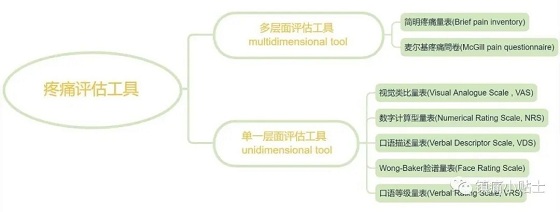
疼痛評估工具可以簡略分為「多層面評估工具」(multidimensional tool)與「單一層面評估工具」(unidimensional tool)兩類。
「多層面評估工具」認為疼痛整體評估應(yīng)包含生理、感覺、情感、行為及社會文化等多層面的評估,透過病人主訴配合專業(yè)人員的評估,獲致病人疼痛的性質(zhì)與對生活的影響。常見的多層面評估量表,如簡明疼痛量表(brief paininventory)、麥基爾疼痛問卷(McGill pain questionnaire)等。
「單一性疼痛評估量表」則是利用數(shù)字、語詞與圖片讓病人描述疼痛的強度,可提供直接快速的評估結(jié)果。常見的單一性疼痛評估量表則有:視覺類比量表(VisualAnalogue Scale, VAS) 、數(shù)字計算型量表(Numerical Rating Scale, NRS)、口語描述量表(VerbalDescriptor Scale, VDS)、臉譜量表(FaceRating Scale)、口語等級量表(VerbalRating Scale, VRS)。
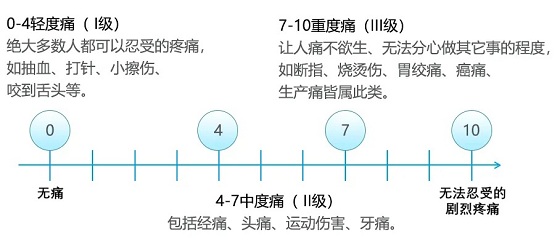
數(shù)字等級量表(NumericalRating Scale,NRS)
病人利用0-10分(或0-100分)的數(shù)字概念,表達從不痛(0分)到最劇烈疼痛(10分或100分)的疼痛程度。4以下為輕度痛(不影響睡眠),4-7為中度痛,7以上為重度痛(導(dǎo)致不能睡眠或從睡眠中痛醒)。
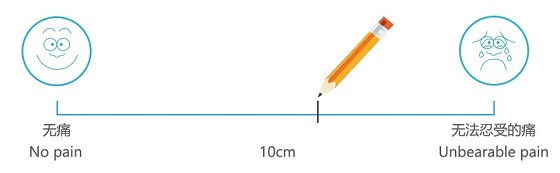
視覺類比量表(Visual Analogue Scale, VAS)
畫一條10公分線,最左邊表示「不痛」(no pain)到最右邊「無法忍受的痛」(unbearablepain),請患者在線上注記其疼痛的程度。這也是國內(nèi)較常用的疼痛評估工具之一。
語言等級量表(VerbalRating Scale, VRS)
病人就疼痛的強度口頭表達「不痛」(None)、「輕微痛」(Mild)、「中度疼痛」(Moderate)、「嚴重疼痛」(Severe)等疼痛程度。
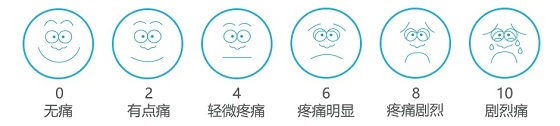
Wong-Baker面部表情量表(Wong-BakerFace Rating Scale, FRS)
病人依照下述6個臉譜表達個人疼痛強度。
參考文獻
[1] Chou R, Gordon DB, de Leon-Casasole OA, Rosenberg JM, Bickler S, Brennan T et al. Management of postoperative pain: a clinical practice guideline from the American Pain Society, the American Society of Regional Anesthesia and Pain Medicine, and American Society of Anesthesiologists’ Committee on Regional Anesthesia, Executive Committee, and Administrative Council. The Journal of Pain. 2016;17(2):131-157.
[2] Mcguire D B . Comprehensive and multidimensional assessment and measurement of pain[J]. Journal of Pain and Symptom Management, 1992, 7(5):312-319.
[3] Flaherty S A . Pain measurement tools for clinical practice and research[J]. Aana Journal, 1996, 64(2):133-40.
[4] 嚴廣斌. NRS疼痛數(shù)字評價量表numerical rating scale[J]. 中華關(guān)節(jié)外科雜志(電子版), 2014(3):410-410.
[5] Bodian C A , Freedman G , Hossain S , et al. The Visual Analog Scale for Pain[J]. Anesthesiology, 2001, 95(6):1356-1361.
[6] Holdgate A , Asha S , Craig J , et al. Comparison of a verbal numeric rating scale with the visual analogue scale for the measurement of acute pain[J]. Emergency Medicine Australasia, 2003, 15(5-6):441-446
[7] Wong D L , Baker C M . Pain in Children: Comparison of Assessment Scales[J]. Pediatric Nursing, 1988, 14(1):9.